
PPDB-PFC Relationship
Introduction
The Pesticide Properties DataBase (PPDB) (along with its sister database the BioPesticide DataBase - BPDB) and the Pesticide Formulations Catalogue (PFC) are complementary resources that provide two different, but closely connected, perspectives on pesticides. They are both service products provided and owned by the Agriculture and Environment Research Unit (AERU) at the University of Hertfordshire.
Both systems are offered as a free-to-use (but not free to duplicate!) websites which are also offered, under licence, as MS Access and MS Excel files. This enables their use offline, for incorporation into third-party software and to enable the data to be explored in depth.
The PPDB (Tzilivakis et al., 2026; Lewis et al., 2016) is primarily concerned with pesticide active substances: their identity, properties, environmental fate, toxicology, ecotoxicology, regulatory status and implications for risk assessment. The PFC, by contrast, is primarily concerned with commercial pesticide products: the formulated products that are placed on the market and used in agriculture, horticulture, amenity areas, forestry, public health and other applications. Whilst the PFC offers value as a stand-alone product, it can also be viewed as an extension and upgrade to the commercial information available with the PPDB.
The relationship between the PPDB and the PFC
A pesticide product is rarely the same thing as the active substance itself. The active substance is the component intended to produce the pesticidal effect. It may be an insecticide, fungicide, herbicide, acaricide, nematicide, plant growth regulator, molluscicide or another type of pesticidal substance. However, commercial products normally contain much more than the active substance(s) alone. They may contain solvents, carriers, surfactants, emulsifiers, stabilisers, preservatives, adjuvants, safeners, fillers and other coformulants. The formulation is designed to make the active substance suitable for storage, handling, application and delivery to its target. Hence, a pesticide active substance is often available in a multitude of different products, alone or in combination with other active substances and presented as concentrated liquids, emulsions, granules etc.
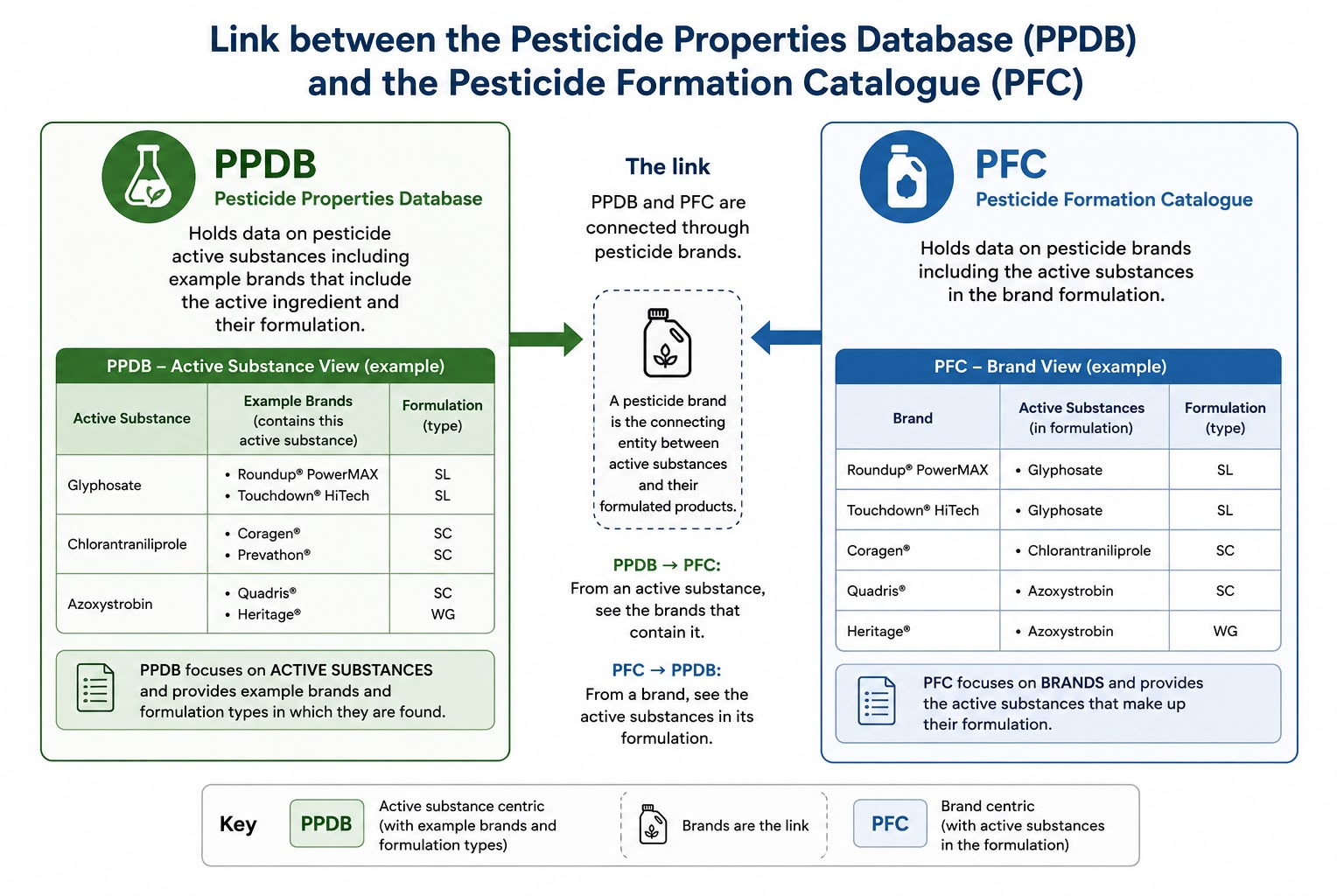
The PPDB starts with the active substance and provides information about its intrinsic properties. The PFC starts with the product and identifies the active substances and formulation characteristics associated with that product. This creates a two-way information pathway with a particular pesticide product acting as the link. This is illustrated in the diagram below.
The role of the PPDB and PFC in risk management
One of the most important benefits of linking the two resources is that it helps bridge the gap between information about an active substance and information about how that substance occurs in actual pesticide products.
Pesticide risk assessments often begins with the properties of an active substance. However, real-world pesticide use takes place through formulated products, not through abstract active substances. A farmer, grower, pest-control professional or other pesticide user does not normally purchase "active substance X" in isolation. They purchase a particular commercial product containing a specified concentration of one or more active substances in a particular formulation. The formulation usually contains many other substances beyond the core active pesticide substances. This is where the PFC adds an important layer of information, giving a wider scientific context.
Firstly, a pesticide’s formulation type, whether a soluble liquid, suspension concentrate, emulsion, wettable granule, or dry granule, can significantly shape both its environmental impact and toxicity profile, even when the active substance is identical. The formulation determines how the product behaves after application: how it spreads, persists, moves through soil or water, interacts with non target organisms, and how easily humans or wildlife can be exposed. For example, soluble liquids dissolve completely in water, creating mobile solutions that can infiltrate soil or leach into groundwater more readily. Their high bioavailability can increase acute exposure risks for aquatic organisms. In contrast, suspension concentrates contain solid particles dispersed in water; they reduce solvent use and often have lower volatility, but the fine particles can drift or settle unevenly, affecting non target plants or sediment dwelling species. Dry formulations such as wettable granules and dry granules typically pose lower inhalation and dermal risks to applicators because they are less dusty and less prone to splash or spill. Environmentally, granules tend to stay where they are placed, reducing drift and off target deposition. However, granules can be ingested by birds or small mammals, creating a different exposure pathway. Emulsifiable concentrates often contain petroleum based solvents that increase dermal absorption and can contribute to environmental toxicity independent of the active ingredient; they also tend to be more volatile, increasing atmospheric transport and potential for odour or vapour drift. Consequently, the physical state of a pesticide product is an important risk assessment aspect.
Secondly, pesticide product coformulants, that is the non-pesticidal active ingredients blended into a commercial chemical mixture to enhance its usability, stability, and effectiveness, often account for the majority of the product mass applied. These coformulants will have their own environmental and toxicity profiles. Very few of these substances are so inert that they could be ignored in a risk assessment. That said, often the necessary environmental fate, transport and toxicological data is scant, may not exist in the public domain (if at all) and can be difficult to locate.
Over the coming months additional records for the more common coformulants will be added to the PPDB/BPDB and existing records expanded to begin to fill this data gap. However, it needs to be noted that many coformulants associated with a particular product are not publicly declared. There are two main reasons for this. Firstly, the full formulation ‘recipe’ is, perhaps, understandably, considered proprietary information i.e. a trade secret. Secondly, in many countries only the coformulants that are considered hazardous are declared in safety data sheets (SDS). Whilst in other countries is not legal requirement for any coformulants to be declared beyond the core active substances. Consequently, collating a full list of coformulants in any particular product is rarely possible.
Nevertheless, the combined resources of the PPDB/BPDB and the PFC are particularly useful for researchers, regulators, consultants, manufacturers, pesticide professionals, academics and others who need to move between active-substance information and product information.
References
Tzilivakis, J., Lewis, K.A., Green, A. and Warner, D.J. (2026) A decade of growth and impact of the Pesticide Properties Database (PPDB). Human and Ecological Risk Assessment: An International Journal, 32(6), 1104-1129. DOI: 10.1080/10807039.2026.2702066
Lewis, K.A., Tzilivakis, J., Warner, D. and Green, A. (2016) An international database for pesticide risk assessments and management. Human and Ecological Risk Assessment: An International Journal, 22(4), 1050-1064. DOI: 10.1080/10807039.2015.1133242
For a PDF version of this text please click here.
© Copyright University of Hertfordshire, 2006-2026. All Rights Reserved
Your use of this website and its various databases is subject to the terms detailed in the University of Hertfordshire’s copyright and IPR statement that can be found at https://www.herts.ac.uk/about-us/legal. In addition, your use of this website and its various databases is subject to the terms of this additional Copyright Statement and the database Conditions of use. Unless explicitly stated otherwise, the content of this website and databases are owned and controlled by the University of Hertfordshire. Site content, including its selection and arrangement, is owned by the University of Hertfordshire and is protected by copyright and other laws. Except as otherwise expressly permitted under copyright law or within the database Conditions of Use document, the content of this site may not be copied, reproduced, republished, downloaded, posted, broadcast or transmitted in any way without first obtaining the University of Hertfordshire’s written permission. By using our databases the user is deemed to have agreed to comply with all of the terms and conditions as described above and within all relevant documentation.
Developed by the Agriculture and Environment Research Unit (AERU) at the University of Hertfordshire, UK.